Japanese only

Japanese only.
2012/05/03 12:12
Comments
(0)
Trackback
(0)

New Selection of Works Introduced in Part II Starting fr...

From Hara Museum ARC, Gunma

New Selection of Works Introduced in Part II Starting from April 27 (Friday)

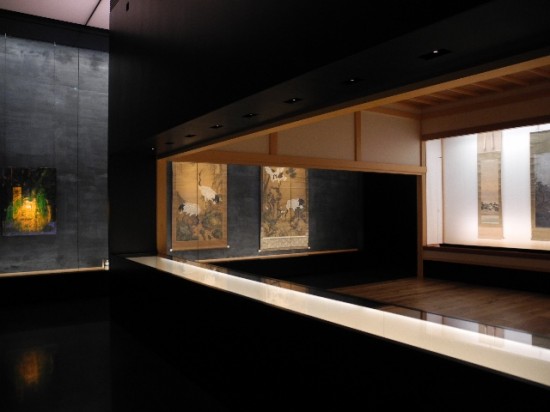
In Part II of Silent Radiance–Selections from the Hara Rokuro Collection on view at the Kankai Pavilion, a number of new works have been introduced. These include Kano Eitoku's Tiger in a bamboo grove, originally one of the wall paintings at the Nikko-in of Mi'idera temple that now comprise the heart of the collection; Portrait of Lie Zi by Sesson, whose deft brushwork imbues a sense of movement in this image of a sage floating in space; and A pair of cranes and an old pine tree by the Chinese painter Shen Nanpin, who introduced a new style to the Edo-period painting. Other paintings and calligraphic works selected for their elegant brilliance are on display, such as the flowing script of Hon'ami Koetsu, one of the three master calligraphers of the Kan'ei Period, in a scroll of waka poems on a painted ground with butterflies.


Hon’ami Koetsu, Waka poems from Book One, Haru no Uta (spring poems), Kokin Wakashu on painted ground with butterflies (part), Edo period

In this hand-scroll, waka poems from the Spring chapter of the anthology Kokin Wakashu are written over a gold- and silver-tone under-paintings of fluttering butterflies. The characters are boldly written in the chirashigaki (scattered writing) style of calligraphy. A butterfly pattern was often used in wood block-printed waka hand-scrolls of Koetsu’s calligraphy, but examples of actual brushwork by Koetsu are very rare.

Featured works (selected)
Traditional Art:
Sesson Portrait of Lie Zi Muromachi period/Kano Eitoku Tiger in a bamboo groove (part of paintings used for wallpaper and sliding doors at Nikko-in guest hall in Mi'idera temple) four hanging scrolls, Momoyama period/Kano Tan'yu Avalokitesvara appearing from the clam Edo period/Shen Nanping A pair of cranes and an old pine tree Qing dynasty, Hon’ami Koetsu, Waka poems from Book One, Haru no Uta (spring poems), Edo period, and others

Contemporary Art:
Anish Kapoor void 1992/Hitomi Uchikura Lumiēre 2007/Izumi Kato Untitled 2008, and others

Place: Hara Musem ARC (2855-1, Kanai, Shibukawa-shi, Gunma 377-0027)
Tel: 0279-24-6585
Organized by: Hara Museum of Contemporary Art
Hours: 9:30 am-4:30 pm*Last entry 30 minutes before closing
Closed: Thursdays (except May 3)
*Closed temporarily in the event of severe weather.
Admission: General (over 12) 1,000 yen; Children (over 3) 500 yen; 10% discount for a group of 20 or more.
**Children must be accompanied by an adult ***Combination ticket for Hara Museum ARC and Ikaho Green Bokujo ranch: General 1,800 yen; Children 900 yen (except April 29, May 3 - 6)

Hara Museum ARC is now participating in MuPon (museum discount ticket system using iPhone application) !

Visit Hara Museum ARC and Hara Museum Twitter (in Japanese only) http://twitter.com/HaraMuseumARC (account name: @HaraMuseumARC)
http://twitter.com/haramuseum (account name: @haramuseum)

http://www.haramuseum.or.jp (museum website)
http://mobile.haramuseum.or.jp (mobile site)

Getting There
By train: Take the Joetsu Shinkansen to Takasaki, change to
the Joestu Line, and disembark at Shibukawa. From Shibukawa, ARC is 10
minutes away by taxi or 15 minutes by bus (take the Ikaho Onsen bus to ″
Green Bokujo Mae″). By car: 8 kilometers (about 15 minutes) from the
Kan-etsu Expressway Shibukawa Ikaho Interchange (in the direction of Ikaho
Onsen).

By Train
◇By JR Joetsu・Nagano Shinkansen 
Recommended timetable
・8:04 Depart Tokyo Station→9:05Arrive at Takasaki Station/ 9:17 Depart
Takasaki Station→9:42Arrive at Shibukawa Station
・11:44 Depart Tokyo Station→12:33Arrive at Takasaki Station/ 12:50 Depart
Takasaki Station→13:14 Arrive at Shibukawa Station
・12:24 Depart Tokyo Station→13:14 Arrive at Takasaki Station/ 13:31 Depart
Takasaki Station→13:58Arrive at Shibukawa Station

◇By JR Joetsu Limited Express Kusatsu
・9:00 Depart Ueno Station→10:39Arrive at Shibukawa Station
(No.3; operates only on Saturdays, Sundays and holidays)
・10:00 Depart Ueno Station→11:44 Arrive at Shibukawa Station (No.1)
・12:00 Depart Ueno Station→13:42 Arrive at Shibukawa Station (No. 3)

From Shibukawa Station, take the Kan-etsu Kotsu Bus and get off at the
station “Green Bokujo Mae.”
http://www.kan-etsu.net/r-bus/timetable/shibu-ikaho-1.htm (in Japanese
only). ARC is about 7 minute walk from the bus station.

By Car
Take the Kan-etsu Expressway to Shibukawa Ikaho Interchange. Go in the
direction of Ikaho Onsen for 8 km (about 15 min.) .

Highway information:
E-NEXCO Drive Plaza http://www.driveplaza.com/ (in Japanese only)

Express Bus (Shinjuku-Ikaho)
Jyosyu Yumeguri Go
Persons who use Shinjuku or Nerima stations will find this express bus very convenient.

View us on Google Maps.

2012/04/24 17:45
Comments
(0)
Trackback
(0)

Keiichiro Shibuya Piano Solo Concert, May 12 at Hara Mus...

Keiichiro Shibuya Solo Piano Concert

「ATAK018 Memories of Origin Hiroshi Sugimoto Concert Version」
at the Hara Museum of Contemporary Art


For one evening only, the Hara Museum will hold a piano and computer concert by Keiichiro Shibuya, who composed music for the documentary movie Memories of Origin Hiroshi Sugimoto.

Since founding the music label ATAK in 2002, Keiichiro Shibuya has explored the relationship between technology and music with dedicated focus, becoming the most talked-about musician active today. His work spans a wide spectrum of musical genres—from electronic music utilizing computer technology to simple, beautiful piano solos and pop music. He continues to actively expand into new areas, such as music for movies and television, live performances and participation at major music festivals throughout the world.

In addition, he created the sound installation "filmachine" at the Yamaguchi Center for Arts and Media (YCAM) in 2006. He released the CD version "ATAK010 filmachine phonics Keiichiro Shibuya" in 2007, the world's first 3-D CD designed for headphone listening which earned him a honorary mention in the digital music division of Austria's Ars Electronica in the same year. In this and other experimental efforts that push the musical envelope, he has received high critical praise.

The centerpiece of the concert will be music from "ATAK018 Soundtrack for Memories of Origin Hiroshi Sugimoto,” Shibuya's most recent album in which he explores the possibilities of the piano. Composition, performance and recording were all done by the artist himself.

Date: Saturday, May 12, 2012
Door opens at: 17:30 / Starts at: 19:00 / Ends at: 20:30

Artist: Keiichiro Shibuya (piano, computer)

Venue: Courtyard garden (outdoors) at the Hara Museum of Contemporary Art
4-7-25 Kitashinagawa, Shinagawa-ku, Tokyo
* The performance will be held outdoors even in case of light rain, and indoors (The Hall) in case of heavy rain. Please refer to the information below for details.

TICKETS: Advance tickets/Reservation tickets: 4,000 yen/Same-day tickets: 4,500 yen
(ticket price includes museum admission.) Ticket holders may view the on-going exhibition Hiroshi Sugimoto: From naked to clothed.
* ADVANCE AND RESERVATION TICKETS NOW SOLD OUT.
* SAME-DAY TICKETS will be available (4,500 yen, limited 50 tickets) from 11:00 at the museum reception desk.
* The museum door will be open at 17:30 (the museum will be closed between 17:00 - 17:30) and the concert will start at 19:00.
For more information, please inquire at the reception desk.


NOTES
* Please go to the Hara Museum website to confirm the performance venue (indoor/outdoor) before coming to the performance.
* Even in case of light rain, the performance will be held outdoors. Please bring a raincoat and towel, etc., as umbrella use will be allowed.
* In the case of an outdoor performance, seating will be on the lawn. A small plastic sheet will be provided.
* No refunds will be given for advance tickets.
* Food and drink will not be allowed inside the museum galleries.

Organized by: Hara Museum of Contemporary Art
Cooperation provided by: SHOUT inc.

http://www.haramuseum.or.jp
http://mobile.haramuseum.or.jp
http://www.art-it.asia/u/HaraMuseum
http://twitter.com/haramuseum


KEIICHIRO SHIBUYA
Musician. Born in Tokyo 1973. Graduated with a degree in composition from Tokyo National University of Fine Arts and Music. In 2002, established the music label ATAK, releasing CDs of domestic and overseas cutting-edge electro-accoustic works, including such representative works as “ATAK000+” and “ATAK010 filmachine phonics.” In 2009, he released his first solo piano album, “ATAK015 for maria.” In 2010, he released “Our Music The Principle Of Relativity + Keiichiro Shibuya .” This was followed by a succession of musical scores for movies and television, including the TBS drama “Spec,” the Shusaku Arakawa documentary “Children Who Won't Die,” and the movies “Seiji Riku no Sakana” and “Memories of Origin Hiroshi Sugimoto,” both of which were screened in 2012. In 2012, he released his first single, “Sacficie Keiichiro Shibuya feat. Rina Ohta” His activities continue to expand into a variety of areas that include concerts and large-scale multi-channel sound installations in Japan and abroad. http://atak.jp/

------------------------------------------------
Hara Museum of Contemporary Art
Hiroshi Sugimoto: From naked to clothed
March 31 (Saturday) - July 1 (Sunday), 2012
2012/04/18 18:43
Comments
(0)
Trackback
(0)

Japanese only

Japanese only.
2012/04/08 15:55
Comments
(0)
Trackback
(0)

Together in One Space: Endo and Sugimoto. (Gunma)

Together in One Space: Toshikatsu Endo and Hiroshi Sugimoto.
Hara Museum ARC, Gunma


Spring is upon us at Hara Museum ARC and the cherry trees are on the verge of blossoming. The spirit of the new season is clearly reflected in the two exhibitions currently on view: Joyous Journeys--Selections from the Hara Museum Collection (in the contemporary art galleries) and Silent Radiance–Selections from the Hara Rokuro Collection (in the Kankai Pavilion). Today, we take a look at two masterworks of contemporary art which have been brought together in same space.


Front: Toshikatsu Endo, Lotus,1989 ; Rear: Hiroshi Sugimoto, Hall of Thirty-Three Bays, 1995 (set of 48 prints)

Tokikatsu Endo, Lotus
Gallery A is noted for its four large pillars that support the building’s rectangular pyramid-shaped roof, as well as the natural light that gently filters in from the skylight. In the middle of the gallery is a massive work called Lotus by Toshikatsu Endo.

The work projects a powerful presence with its charred surface and large circular form. A look at the inner circle reveals it to be layered with steel and brimming with water. What can it all mean?

Hiroshi Sugimoto, Hall of Thirty-Three Bays
Displayed in a line that wraps around the gallery, these photos were taken of the one thousand statues that comprise the Thousand Armed Kannon at Sanjusangendo Temple in Kyoto, each taken at a slightly different angle, as they would look in real life. They were taken over the course of a week, during the early morning hour when golden sunlight streams in. You may feel transported into another dimension as you gaze upon the many-armed Buddhas, captured in that single glowing instant.

These two works of art infuse the gallery with a sense of mystery, making it feel like a temple. Please come and bathe in this feeling, and the special glow that emanates from the works.

Another show that should not be missed is the solo exhibition by Hiroshi Sugimoto, currently on view at the Hara Museum of Contemporary Art in Tokyo. 
Hiroshi Sugimoto: From Naked to Clothed
March 31 (Saturday) – July 1 (Sunday), 2012
Hara Museum of Contemporary Art


Spring Exhibitions at Hara Museum ARC

Joyous Journeys - Selections from the Hara Museum Collection
Saturday, March 17 - Sunday, June 24, 2012 Galleries A, B and C

Silent Radiance-Selections from the Hara Rokuro Collection
Part I: Saturday, March 17 - Wednesday, April 25, 2012
Part II: Friday, April 27 - Wednesday, May 30, 2012
Kankai Pavilion

Place: Hara Museum ARC (2855-1, Kanai, Shibukawa-shi, Gunma 377-0027)
Tel: 0279-24-6585
Organized by: Hara Museum of Contemporary Art
Hours: 9:30 am - 4:30 pm *Last entry 30 minutes before closing
Closed: Thursdays (except May 3)
*Closed temporarily in the event of severe weather.
Admission: General (over 12) 1,000 yen; Children (over 3) 500 yen; 10%
discount for a group of 20 or more.
**Children must be accompanied by an adult
***Combination ticket for Hara Museum ARC and Ikaho Green Bokujo ranch: General 1,800 yen; Children 900 yen (except April 29, May 3 - 6)

Hara Museum ARC is now participating in MuPon (museum discount ticket system
using iPhone application)!

http://www.haramuseum.or.jp (museum website)
http://mobile.haramuseum.or.jp (mobile site)

Follow the Hara Museum and Hara Museum ARC on Twitter and get the latest news:
http://twitter.com/HaraMuseumARC(@HaraMuseumARC)
http://twitter.com/haramuseum (@haramuseum)


Getting There
By train: Take the Joetsu Shinkansen to Takasaki, change to
the Joestu Line, and disembark at Shibukawa. From Shibukawa, ARC is 10
minutes away by taxi or 15 minutes by bus (take the Ikaho Onsen bus to ″
Green Bokujo Mae″). By car: 8 kilometers (about 15 minutes) from the
Kan-etsu Expressway Shibukawa Ikaho Interchange (in the direction of Ikaho
Onsen).

By Train
◇By JR Joetsu・Nagano Shinkansen 
Recommended timetable
・8:04 Depart Tokyo Station→9:05Arrive at Takasaki Station/ 9:17 Depart
Takasaki Station→9:42Arrive at Shibukawa Station
・11:44 Depart Tokyo Station→12:33Arrive at Takasaki Station/ 12:50 Depart
Takasaki Station→13:14 Arrive at Shibukawa Station
・12:24 Depart Tokyo Station→13:14 Arrive at Takasaki Station/ 13:31 Depart
Takasaki Station→13:58Arrive at Shibukawa Station

◇By JR Joetsu Limited Express Kusatsu
・9:00 Depart Ueno Station→10:39Arrive at Shibukawa Station
(No.3; operates only on Saturdays, Sundays and holidays)
・10:00 Depart Ueno Station→11:44 Arrive at Shibukawa Station (No.1)
・12:00 Depart Ueno Station→13:42 Arrive at Shibukawa Station (No. 3)

From Shibukawa Station, take the Kan-etsu Kotsu Bus and get off at the
station “Green Bokujo Mae.”
http://www.kan-etsu.net/r-bus/timetable/shibu-ikaho-1.htm (in Japanese
only). ARC is about 7 minute walk from the bus station.

By Car
Take the Kan-etsu Expressway to Shibukawa Ikaho Interchange. Go in the
direction of Ikaho Onsen for 8 km (about 15 min.) .

Highway information:
E-NEXCO Drive Plaza http://www.driveplaza.com/ (in Japanese only)

Express Bus (Shinjuku-Ikaho)
Jyosyu Yumeguri Go
Persons who use Shinjuku or Nerima stations will find this express bus very convenient.

View us on Google Maps.

2012/04/02 10:44
Comments
(0)
Trackback
(0)

Silent Radiance–Selections from the Hara Rokuro Collecti...

From Hara Museum ARC, Gunma

In Gunma, it is starting to feel like spring at last.
Today, we introduce a work from the Hara Rokuro Collection of traditional East-Asian masterpieces, one of several included in the current exhibition at the Kankai Pavilion, Silent Radiance–Selections from the Hara Rokuro Collection, on view from Saturday, March 17 .

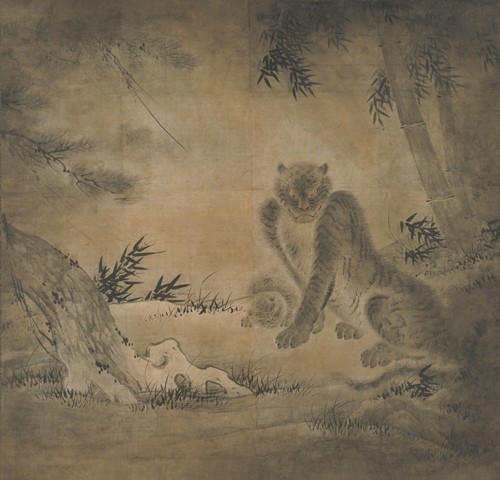
The work in question is Kano Eitoku's Tiger in a bamboo groove, a hanging scroll from the Edo period. It is the first time in two years that this work has been displayed.

Kano Eitoku Tiger in a bamboo groove (part of paintings used for wallpaper and sliding doors at Nikko-in guest hall in Mi'idera temple) hanging scroll, Momoyama period

This work once adorned a wall. The fact that very few Eitoku paintings exists today raises the intrinsic value of this painting for scholars who study the artist. The wall in question was at the Nikko-in guest hall at Mi'idera temple (Onjoji) in Shiga prefecture. It was later converted into the form of a hanging scroll.

In this large-sized painting, we see a mother tiger and her cub resting in a wind-blown bamboo grove. The mother’s tense expression and fluid posture imply a readiness to defend her sleeping cub. This painting is similar to another painting called Tiger and Bamboo by Eitoku’s father Kano Shoei (1519-92) (in the Juko-in sub-temple of Daitokuji Temple, Kyoto). However, in the painting by Eitoku (1543-90) we feel a pervasive tension that is absent in the one by Shoei.

When you are in front of the painting, look closely at the quality of the line. You will notice how exquisite the atmosphere and objects are expressed by the use of ink alone.

Featured works (selected)
Traditional Art:
【Part I】 Kano Eitoku Tiger in a bamboo groove (part of paintings used for wallpaper and sliding doors at Nikko-in guest hall in Mi'idera temple) hanging scroll, Momoyama period/Kano school Scene based on an old Chinese anecdote ‘Assembly at the Orchid Pavilion’(part of paintings used for wallpaper and sliding doors at Nikko-in guest hall in Mi'idera temple) four hanging scrolls, Momoyama - Edo period/Book of model handwriting, called 'Reiso-dai' Nara - Muromachi period, and others
【Part II】 Sesson Portrait of Lie Zi Muromachi period/Kano Eitoku Tiger in a bamboo groove (part of paintings used for wallpaper and sliding doors at Nikko-in guest hall in Mi'idera temple) four hanging scrolls, Momoyama period/Kano Tan'yu Avalokitesvara appearing from the clam Edo period/Shen Nanping A pair of cranes and an old pine tree Qing dynasty, and others

Contemporary Art:
Anish Kapoor void 1992/Hitomi Uchikura Lumiēre 2007/Izumi Kato Untitled 2008, and others

Place: Hara Museum ARC (2855-1, Kanai, Shibukawa-shi, Gunma 377-0027) Tel: 0279-24-6585
Organized by: Hara Museum of Contemporary Art
Hours: 9:30 am-4:30 pm *Last entry 30 minutes before closing
Closed: Thursdays (except March 22, 29 and May 3) *Closed temporarily in the event of severe weather.
Admission: General (over 12) 1,000 yen; Children (over 3) 500 yen; 10% discount for a group of 20 or more.
**Children must be accompanied by an adult ***Combination ticket for Hara Museum ARC and Ikaho Green Bokujo ranch: General 1,800 yen; Children 900 yen (except April 29, May 3 - 6)

Hara Museum ARC is now participating in MuPon (museum discount ticket system using iPhone application) !
http://www.tokyoartbeat.com/apps/mupon

Visit Hara Museum ARC and Hara Museum Twitter (in Japanese only) http://twitter.com/HaraMuseumARC (account name: @HaraMuseumARC)
http://twitter.com/haramuseum (account name: @haramuseum)

http://www.haramuseum.or.jp (museum website)
http://mobile.haramuseum.or.jp (mobile site)
2012/03/30 17:15
Comments
(0)
Trackback
(0)

No English contents

No English contents.
2012/03/23 11:02
Comments
(0)
Trackback
(0)

Pâques (Easter) Celebration 2012 - Where Is Your Rabbit?...

Pâques (Easter) Celebration 2012
- Where Is Your Rabbit? Chocolate Hunt in the Hara Museum Garden –

All tickets sold out for today's Easter game. Visitors however are welcome to watch the chocolate-making demonstration at the Hall (from 13:00 to 15:30). Museum admission required.

----
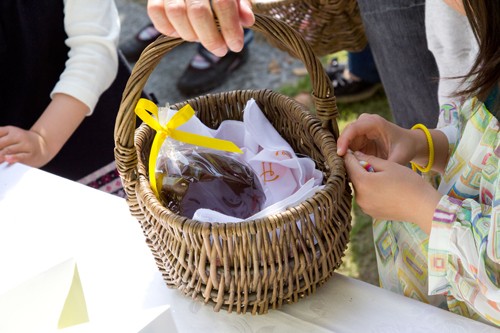
For children in Europe, Easter (or "Pâques" in French), often means hunting for gaily decorated Easter eggs and chocolate bunnies that have been hidden beforehand in the family garden. This year, once again, the renowned French patissier Pierre Hermé Paris brings the Easter egg hunt to the Hara Museum garden. Participants will enjoy searching for Easter eggs and chocolate bunnies hidden in the garden. In The Hall will be a special chocolate-making workshop. Family participation is welcomed.


[Information]
Date: April 8 (Sunday), 2012 *Content of the event may change slightly in case of rain.

Place: The Hara Museum Courtyard Garden and The Hall 
4-7-25 Kitashinagawa, Shinagawa-ku, Tokyo 140-0001 Tel: +81 3-3445-0651

Time: Three sessions: 1:00 pm (for children of age 3 to 12 years old only)/ 2:00 pm/ 3:00 pm)

Number of participants: Limited to 20 persons per session
Organized by: Hara Museum of Contemporary Art and PIERRE HERMÉ PARIS

Reservations: Reservations will be accepted as follows:
Advanced reservations will be accepted at Pierre Hermé Paris. Please call their boutique at 03-5485-7766 (11:00 – 20:00) or check their website for details (http://pierreherme.co.jp).
Limited number of tickets (5 per session) will be available at the museum on the day of the event from 11:30 am on a first come, first served basis.

Admission: Free with the museum admission [General 1,000 yen; Students 700 yen (high school and university) or 500 yen (elementary and junior high)]

Organized by: Hara Museum of Contemporary Art and PIERRE HERMÉ PARIS

-----------------------------------
Hara Museum of Contemporary Art, Tokyo

Jean-Michel Othoniel, My Way
January 7 (Saturday) – March 11 (Sunday), 2012

Hiroshi Sugimoto: From naked to clothed
March 31 (Saturday) – July 1 (Sunday), 2012
2012/03/07 18:07
Comments
(0)
Trackback
(0)

Projection Mapping + Performance Vol.1 BYAKUYA is now on...

From the Hara Museum, Tokyo

Last year's 、BYAKUYA event that took place in the Hara Museum courtyard garden is now on DVD!

On the first weekend of October, this multimedia extravaganza incorporated the dance performance of Ikuyo Kuroda, the music of Jiro Matsumoto and a cast of characters in a production that unfolded against an ever-changing backdrop created by film director and image maker Shutaro Oku using Projection Mapping, a technique of directly projecting visual imagery onto architectural surfaces using theatrical equipment. The response to the event was extraordinary.

Sale of the DVD has already begun at The Museum Shop at the Hara Museum on Friday, March 9, prior to its general release on Friday, March 16.


BYAKUYA DVD
Price: 3,675 yen; product number: NEGA-11006
The Museum Shop at the Hara Museum [Tel: 03-3445-2069 (direct line)]
※The Museum Shop will be closed during an exhibition change over from March 12 (Friday) to March 30 (Monday).


For the report on the BYAKUYA event, click here.


Director Oku and the people at NEGA Corporation provided a beautiful example of Projection Mapping during the opening reception of Jean-Michel Othoniel, My Way in January.
http://www.okushutaro.com
http://nega.co.jp


Here is Kokoro, Othoniel's permanent installation at Hara Museum ARC (Hara Museum's annex in Gunma prefecture), appearing in all its glory inside the museum's courtyard garden! (Photo: Hirotaka Yonekura)

-----------------------------------
Hara Museum of Contemporary Art, Tokyo

Jean-Michel Othoniel, My Way
January 7 (Saturday) – March 11 (Sunday), 2012

Hiroshi Sugimoto: From naked to clothed
March 31 (Saturday) – July 1 (Sunday), 2012
2012/03/07 16:45
Comments
(0)
Trackback
(0)

Joyous Journeys

From Hara Museum ARC, Gunma


From the left: Kano Eitoku Tiger in a bamboo groove (part of paintings used for wallpaper and sliding doors at Nikko-in guest hall in Mi'idera temple) hanging scroll, Momoyama period /Tadanori Yokoo DNF: Anya Kouro City of Insomnia 2001

Joyous Journeys – Selections from the Hara Museum Collection
Saturday, March 17 – Sunday, June 24, 2012 Galleries A, B and C


The Ikaho region where Hara Museum ARC is situated has long flourished as one of Japan's preeminent tourist spots. Praises for Ikaho can be found as far back as the ancient anthology of poetry, the Manyoshu. During the Edo period, it was admired for the therapeutic value of its hot springs, for its views of Mt. Haruna and for visits to Mizusawa Temple on New Year's Day. Nowadays, the Japanese word ″tourism″ generally means travel for the purpose of enjoyment. But digging into its roots, we find the same expression in Chinese classics that literally means ″to see the light of the country.″ Could this light be the indescribable glow that emanates from the sight of people living happy lives?
For this exhibition, we have thus chosen art from the Hara Museum Collection that exemplifies this interpretation — art that is filled with the joy, comfort and brilliance of life. We hope you will come on a ″tour″ of the museum and be bathed in the joyous glow of its art.

Featured artists: Toshikatsu Endo/Yayoi Kusama/Hiroe Saeki/Tokihiro Sato/Hiroshi Sugimoto/Tabaimo/Kohei Nawa/Hiroharu Mori/Tadanori Yokoo/Cao Fei/George Rickey/Sigmar Polke/Piotr Kowalski and others


Silent Radiance–Selections from the Hara Rokuro Collection
Part I: Saturday, March 17 – Wednesday, April 25, 2012
Part II: Friday, April 27 – Wednesday, May 30, 2012

Kankai Pavilion

The masterworks of Far Eastern art that the Meiji-era businessman Hara Rokuro collected over the course of his life comprise the present-day Hara Rokuro Collection, with Japanese paintings of the pre-modern era as its core. This exhibition showcases a number of exquisite paintings and calligraphic works from the collection noted for their elegant radiance. Among these are: Kano Eitoku's Tiger in a bamboo grove from a group of paintings that were originally partition or interior wall paintings at the Nikko-in Mi'idera temple, which comprises the heart of the Hara Rokuro Collection; Sesson's Portrait of Lie Zi, which shows a man floating in the air as he plays a flute, the flowing folds of his robe exquisitely depicted by the artist's unique brushwork; and Reiso-dai, a rare collection of model calligraphy texts.
By displaying selected works of contemporary art together with these traditional masterpieces, the viewer is presented with an aesthetic world interweaving expressions and forms that transcend time and place. We hope you will come and enjoy the beauty of the collections from a variety of perspectives.


Featured works (selected)
Traditional Art: 【Part I】 Kano Eitoku Tiger in a bamboo groove (part of paintings used for wallpaper and sliding doors at Nikko-in guest hall in Mi'idera temple) hanging scroll, Momoyama period/Kano school Scene based on an old Chinese anecdote ‘Assembly at the Orchid Pavilion’(part of paintings used for wallpaper and sliding doors at Nikko-in guest hall in Mi'idera temple) four hanging scrolls, Momoyama - Edo period/Book of model handwriting, called 'Reiso-dai' Nara - Muromachi period, and others

【Part II】 Sesson Portrait of Lie Zi Muromachi period/Kano Eitoku Tiger in a bamboo groove (part of paintings used for wallpaper and sliding doors at Nikko-in guest hall in Mi'idera temple) four hanging scrolls, Momoyama period/Kano Tan'yu Avalokitesvara appearing from the clam Edo period/Shen Nanping A pair of cranes and an old pine tree Qing dynasty, and others
Contemporary Art: Anish Kapoor void 1992/Hitomi Uchikura Lumiēre 2007/Izumi Kato Untitled 2008, and others

Place: Hara Museum ARC (2855-1, Kanai, Shibukawa-shi, Gunma 377-0027) Tel: 0279-24-6585
Organized by: Hara Museum of Contemporary Art
Hours: 9:30 am - 4:30 pm *Last entry 30 minutes before closing
Closed: Thursdays (except March 22, 29 and May 3) *Closed temporarily in the event of severe weather.
Admission: General (over 12) 1,000 yen; Children (over 3) 500 yen; 10% discount for a group of 20 or more.
**Children must be accompanied by an adult ***Combination ticket for Hara Museum ARC and Ikaho Green Bokujo ranch: General 1,800 yen; Children 900 yen (except April 29, May 3 - 6)

Hara Museum ARC is now participating in MuPon (museum discount ticket system using iPhone application)! http://www.tokyoartbeat.com/apps/mupon

Visit Hara Museum ARC and Hara Museum Twitter (in Japanese only) (account name: @HaraMuseumARC @haramuseum)
http://twitter.com/HaraMuseumARC
http://twitter.com/haramuseum

http://www.haramuseum.or.jp (museum website)
http://mobile.haramuseum.or.jp (mobile site)


Enjoying the Cherry Blossoms and Outdoor Sculptural Installations
Scattered on the grounds of Hara Museum ARC are a number of unique artworks by artists on the cutting edge of the art scene, including Kokoro (2009) by Jean-Michel Othoniel, a sculptural piece consisting of linked red Murano-glass globes, and A Fragmentary Anatomy of Every Setting Sun (2010) by the Korean artist Lee Bul, which is encased in a metallic case with its image reflected endlessly into infinity. In the spring, these works compete for your attention with the great variety of cherry blossoms that come into glorious bloom (from mid-April to the beginning of May).


Jean-Michel Othoniel,Kokoro,2009
------------------------------------------------------------------------------------------------------
ACCESS
Getting There: By train: Take the Joetsu Shinkansen to Takasaki, change to the Joestu Line, and disembark at Shibukawa. From Shibukawa, ARC is 10 minutes away by taxi or 15 minutes by bus (take the Ikaho Onsen bus to ″Green Bokujo Mae″). By car: 8 kilometers (about 15 minutes) from the Kan-etsu Expressway Shibukawa Ikaho Interchange (in the direction of Ikaho Onsen).


By Train
By JR Joetsu・Nagano Shinkansen 
Recommended timetable
・08:04Depart Tokyo Station→09:05Arrive at Takasaki Station/ 09:17Depart Takasaki Satation→09:42Arrive at Shibukawa Station
・11:44Depart Tokyo Station→12:33Arrive at Takasaki Station/ 12:50 Depart Takasaki Satation→13:14 Arrive at Shibukawa Station
・12:24 Depart Tokyo Station→13:14 Arrive at Takasaki Station/ 13:31 Depart Takasaki Satation→13:58Arrive at Shibukawa Station

By JR Joetsu Limited Express Kusatsu

・ 9:00 Depart Ueno Station→10:39Arrive at Shibukawa Station (No.31 ; operates only on Saturdays, Sundays and holidays)
・10:00 Depart Ueno Station→11:44 Arrive at Shibukawa Station (No.1)
・12:00 Depart Ueno Station→13:42 Arrive at Shibukawa Station (No. 3)

From Shibukawa Station, take the Kan-etsu Kotsu Bus and get off at the station “Green Bokujo Mae.” http://www.kan-etsu.net/r-bus/timetable/shibu-ikaho-1.htm (in Japanese only). ARC is about 7 minute walk from the bus station.

By Car
Take the Kan-etsu Expressway to Shibukawa Ikaho Interchange. Go in the direction of Ikaho Onsen for 8 km (about 15 min.) .

Highway information:
E-NEXCO Drive Plaza http://www.driveplaza.com/ (in Japanese only)
2012/03/06 15:00
Comments
(0)
Trackback
(0)

1 2 3 4 5 6 7 8 9 10 Next