
The 12th Hiroshima Art Prize: Mel Chin is on view at the Hiroshima City Museum of Contemporary Art through October 12. The Hiroshima Art Prize was established by the City of Hiroshima in 1989 to recognize the achievements of artists who have contributed to the peace of humanity through art and to convey to the world, through art, the “Spirit of Hiroshima,” which wishes for a peaceful world free from nuclear weapons; it has been awarded once every three years. Mel Chin, recipient of the 12th Hiroshima Art Prize in 2024, presents his first solo exhibition in Japan, bringing together his most significant works alongside a new work created specifically for Hiroshima.
This text is an edited transcript of the opening lecture held in the Museum Studio on July 25, 2026, the first day of the exhibition, edited by ART iT and published with the cooperation of the artist and the Hiroshima City Museum of Contemporary Art.
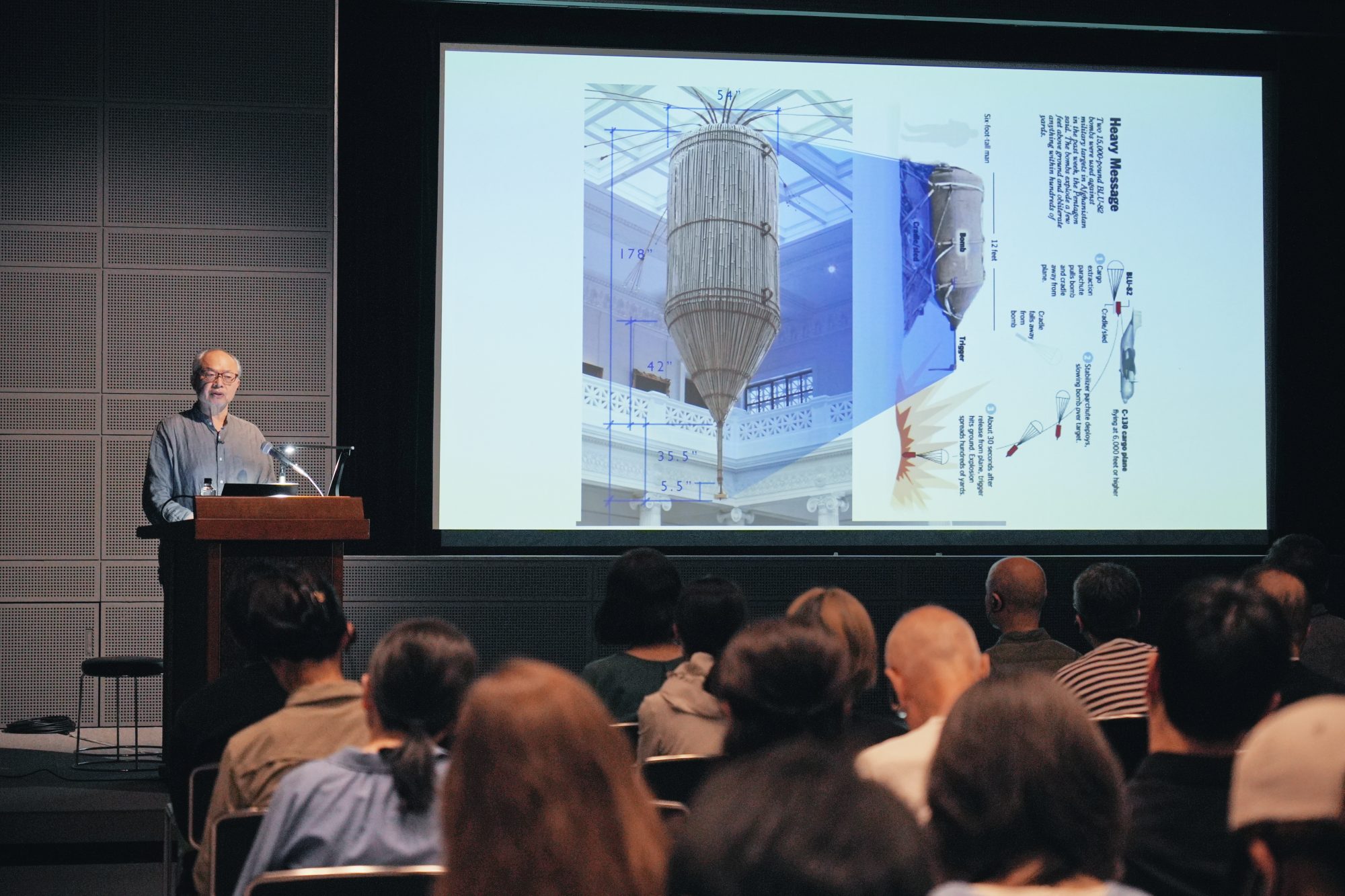 Mel Chin at the Museum Studio (B1F), Hiroshima City Museum of Contemporary Art, July 25, 2026. Courtesy of Hiroshima City Museum of Contemporary Art
Related event: “The 12th Hiroshima Art Prize: Mel Chin”
Opening Lecture: Mel Chin
For this lecture, I think I may be too relaxed, but for my very first lecture in New York, I wasn’t. I was so nervous. It wasn’t because it was New York City, a city of art and ideas. I was invited by a bunch of communists at the New School for Social Research in New York City. They were not art people, but the graduate school of philosophy and psychology. I was terrified because the school of philosophy would know I didn’t know what I was talking about, and the school of psychology would see that I had really deep childhood trauma. So what do you do? I decided to make something.
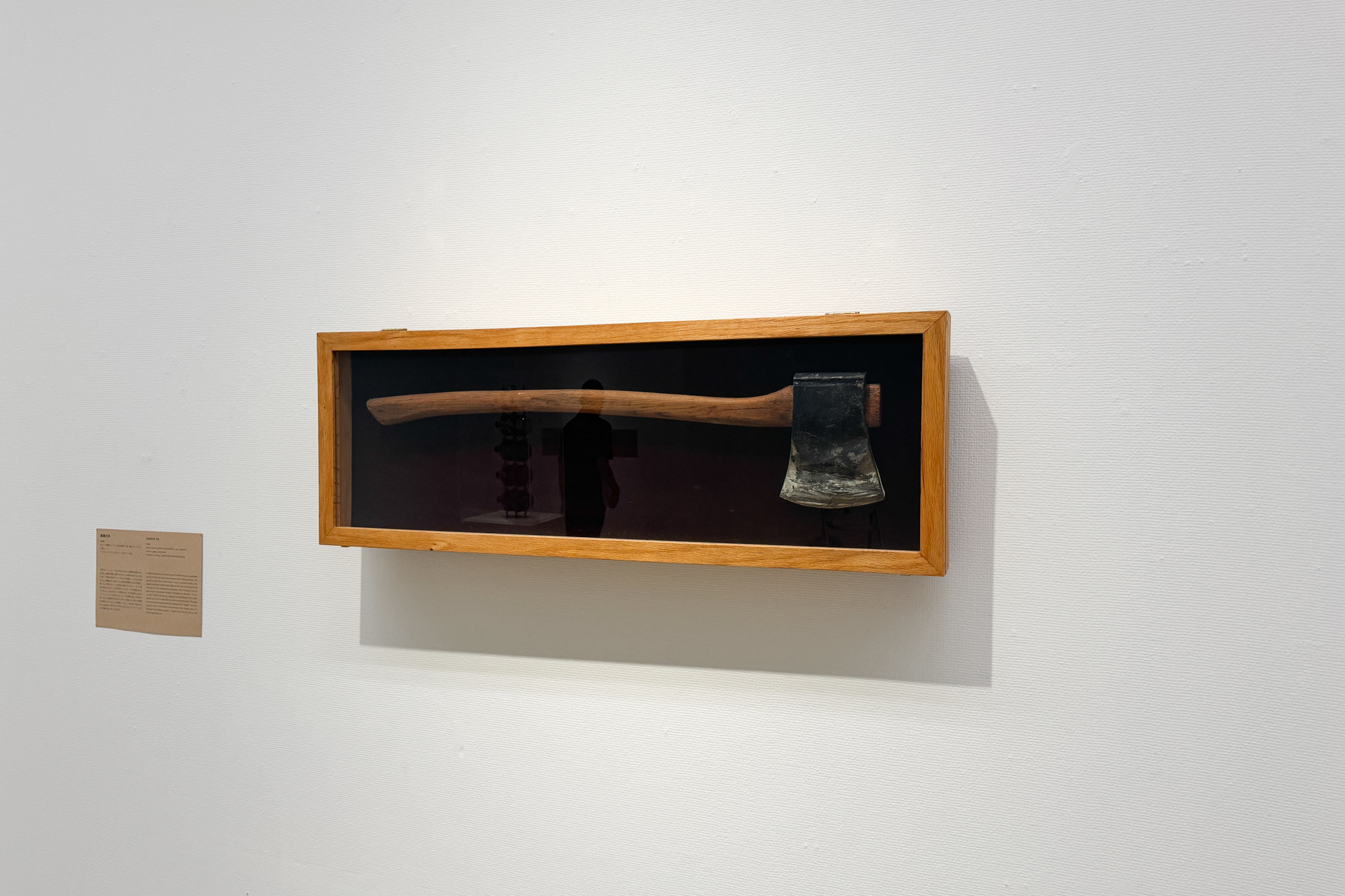 Mel Chin, Lecture Ax (1988)
I got a stick of wood and a book, carved it into the shape of an ax, and wrapped it in paper. Then I bought a six-pack of Budweiser beer. I went to the talk and sat down, and there were all these white men with pipes waiting for me to talk. And I started drinking. By the third beer, I was very red, getting drunk, and had a massive headache. I had not said a word. The head of the psychology graduate students, who had invited me, said, “Mr. Chin, I think it’s time to talk.”
I jumped up, tore the paper off the package, and said, “This is an ax.” And he said, “What the hell are you going to do?” I turned around and smashed it into the wall; the book burst open, and my notes fell out. And I calmly read: “…and Chinese philosophy, you begin with an ax.” The talk was very successful. If you refer to Kafka, you will hear him say, in his own letters, that a book must be an axe for the frozen sea within us. I think I was breaking the ice that day. I don’t have anything like this tonight.
Another important note is that, at the time, I read a book that was very important to me by the American literary scholar Elaine Scarry, The Body in Pain. At the very beginning of the book, Scarry speaks of a line from Homer, the poet who wrote the Odyssey. She quotes a line that was so important to me. Homer says, “the arrow is freighted or loaded with dark pain.” It is an amazing construction. It means that this object, which obviously is just an object, does not have pain. Is it pain? It’s just an arrow. But the human mind and the world of poetry and imagination put upon it that it had this other quality. That is a key to some of my work: that an object can be loaded with ideas. So the Lecture Ax, which is here in this exhibition, was what it was. It was an object of performance, but also a lecture in itself, a lesson that things can be contained in an object without speaking, or in silence.
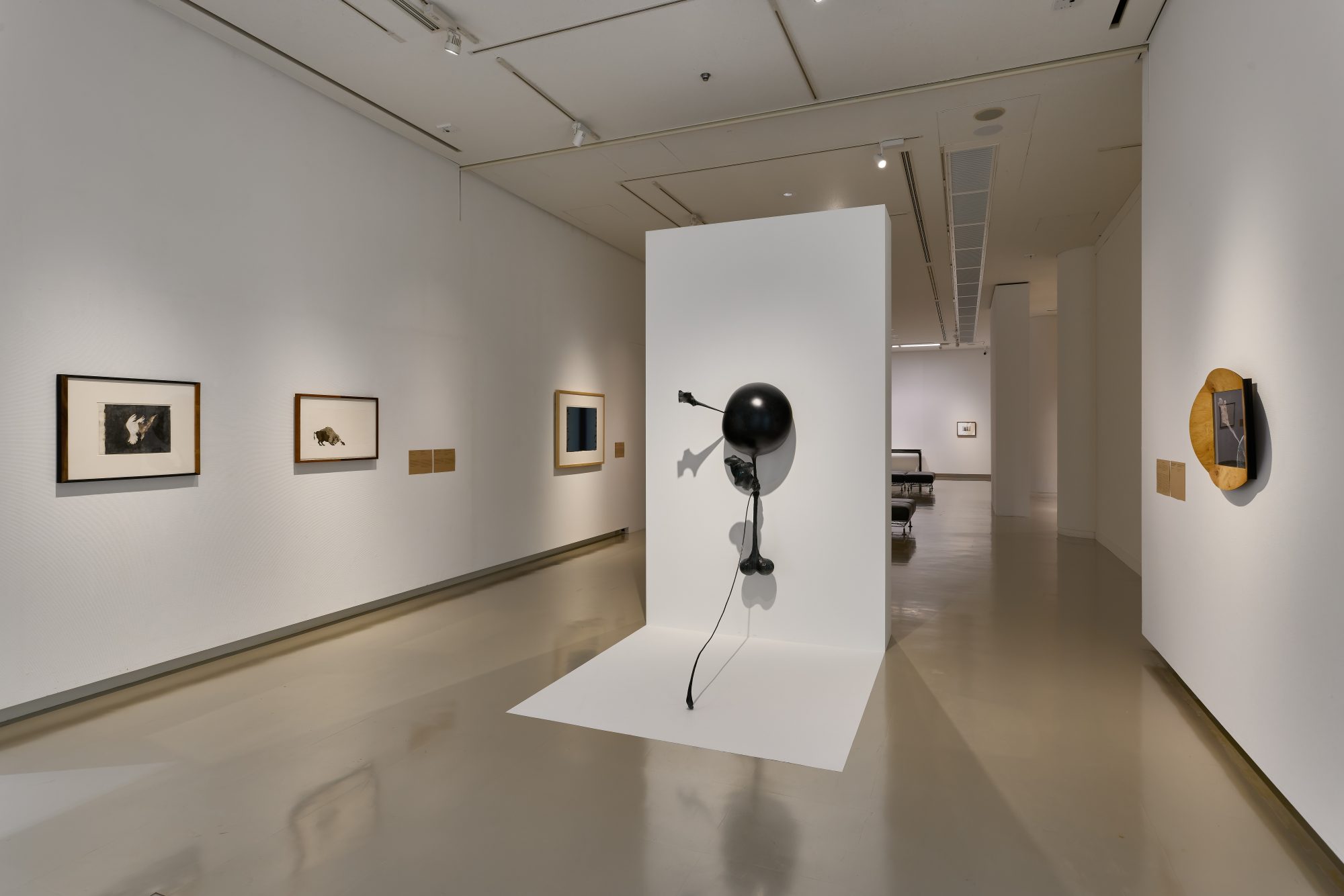 (center) Mel Chin, Shape of a Lie (2006). Photo: Kenichi Hanada
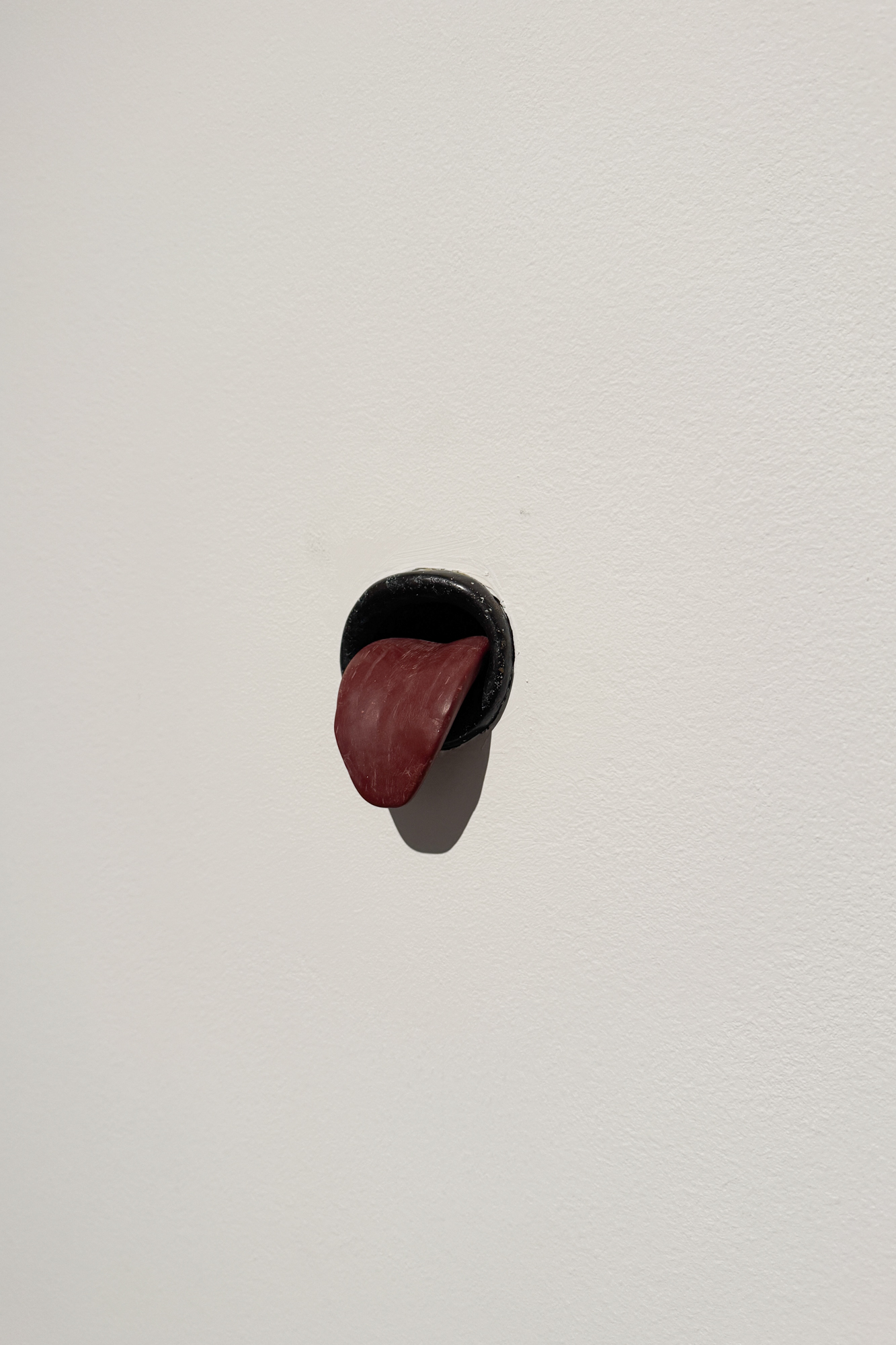 Mel Chin, Shape of a Lie (2006)
As for Shape of a Lie, this is my tongue. I know you’re smart, so you say, “Okay. Mel Chin is Chinese. I got it. I know what this piece is about. It could be related to the Han Dynasty shaman figures with their tongues out. Or maybe earlier, a Zhou Dynasty demon. That tongue thing that the Chinese have.” But you’re wrong. Actually, the piece is a little more complicated, because if you walk around the back of the tongue, you’ll see this strange morphology coming out of it. I will tell you what Shape of a Lie contains.
Let’s talk about what a lie is. It starts with maybe something Socratic: truth. The truth can be a tiny, tiny little tippy-toe. Then that truth goes up. This is a male lie, not a female lie. It’s aided by these gonadic forces, these sexual forces, and you have Mr. Freud checking it out. So you have the little truth, and it goes up there, and it’s joining together, and it’s going up very fast. Then it meets the stomach, the enteric system, as described by Michael D. Gershon, as a second brain, the brain of the stomach. That clenches and says, “Oh no. Damn toe. And damn gonad. Bringing up that lie again.” It’s squeezing it and trying to stop it, and you feel a little bit nervous. That’s the second brain, the primordial brain. But the lie escapes and moves into this other realm. Here you see Henry Moore. It has the look and feel of bronze, the truthful material of art and objects, and the lie is blown up big. Then, from the side, there’s a splinter of reason, a little image wrapped around like a condom, of another famous artist’s work, Giovanni Battista Piranesi’s description of imaginary prisons. The splinter is trying to stop irrationality, trying to spike that lie and stop it before it can get out. But it’s not successful. It goes through and comes out through my mouth, through my tongue. That’s what Shape of a Lie is about. You’ll see it in the gallery. But it’s a little more than that, because it’s also about materials. If you think of bronze as the true material of sculpture, telling the Western, maybe, way of truth and eternity, then we look at another material, Native American pipestone, catlinite. The tongue is carved out of that. So, what does that mean?
If you add it all up, we could talk about the formation of America, and about me as an American, and how maybe I was led to believe things, because I may be living in a country that may be full of lies, or built on treaties that were never respected. The sacred material of the Native American peace pipe was offered to some of the founders to say, “We’ll make a treaty with you. We’ll give you this. You’re here. You’re attacking us, I know. But we’ll make a peace treaty.” Not a single treaty was ever respected. So, what I’m talking about is a reflection of our own history. In all this shape that I’m describing, there are forces, forces that are simplistically seen as black and white. But it’s never that simplistic. I think the black and white actually leads to all kinds of possibilities and tones of understanding. If we read it the way we are taught to read it, we may not read it in its full complexity.
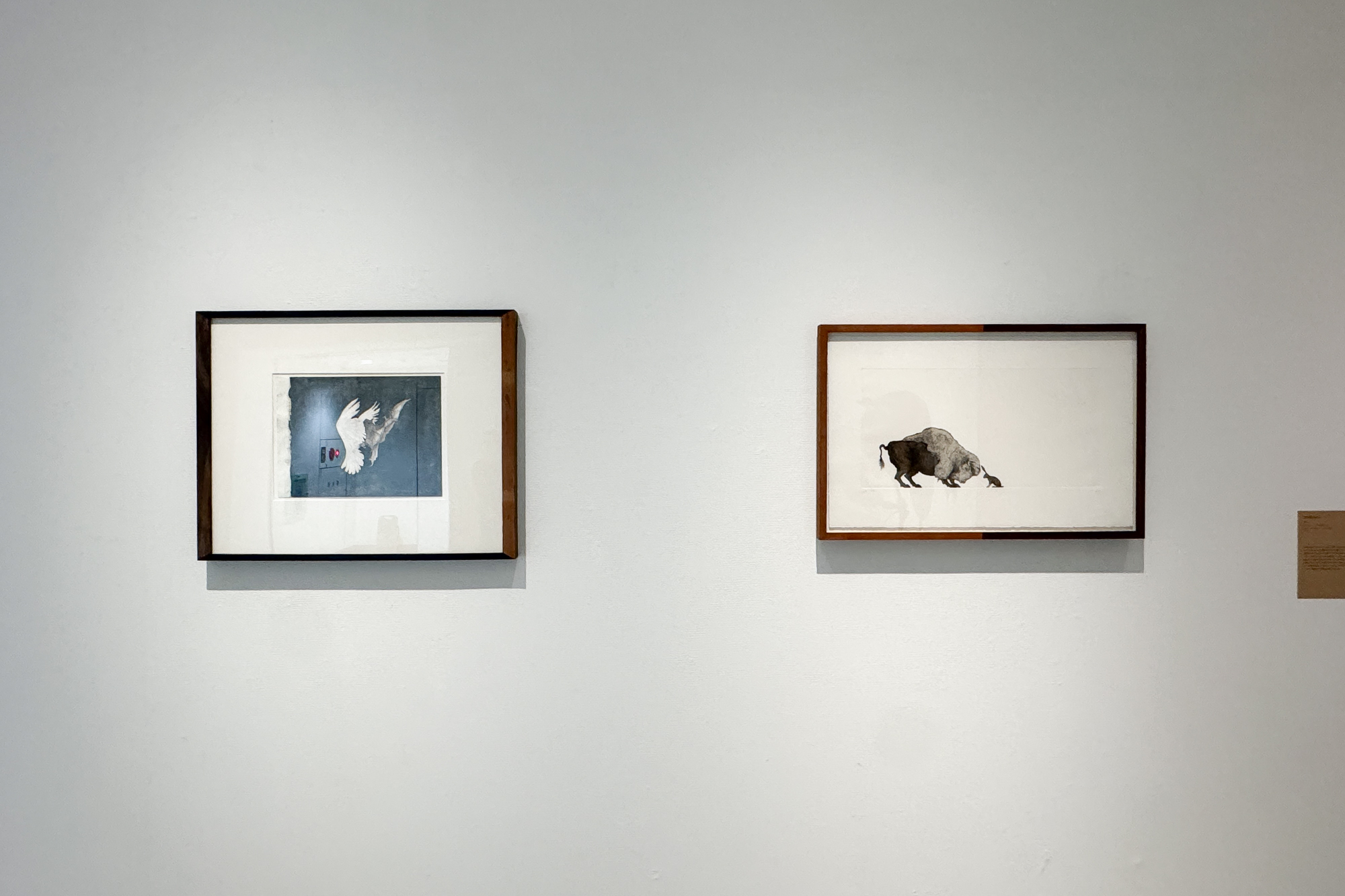 (from left) Mel Chin, Bat and Dove (2007); Self-Portrait (Bison and Hare) (1996)
This piece is Bat and Dove. The dove is white. It’s emblematic of what they call, in some aspects of Western religion, the Holy Spirit. I’m not a Christian, so I’m not an expert. Here the dove is with a bat, and the bat, maybe in Western circles, may be compared to dark forces. But I know. I’m down with you brothers and sisters here. The bat is kind of cool, right?
So you have these opposing readings, one about death, one about life, one about belief. And then there’s a third ambiguity here. Are they about to embrace? Are they about to fight? This is another thing that art can lead you to, that it’s the question that is there for you to own. So when you look at my work, you don’t have to have it all figured out. Even the things I say here are Mel Chin in 2026, on this day. I may change my mind after I leave, so please email me and ask me if it’s still true in a month, and I’ll tell you. But that is the notion of truth. Maybe we should look at ideas as things that move and fly and collide and join and embrace in the air or on the ground. They have this possibility of framing and reframing what you think, because if you allow ideas to move and truly understand the full scope, we may have a better understanding of ourselves. And our relationships. Or I’ll just say it about my own.
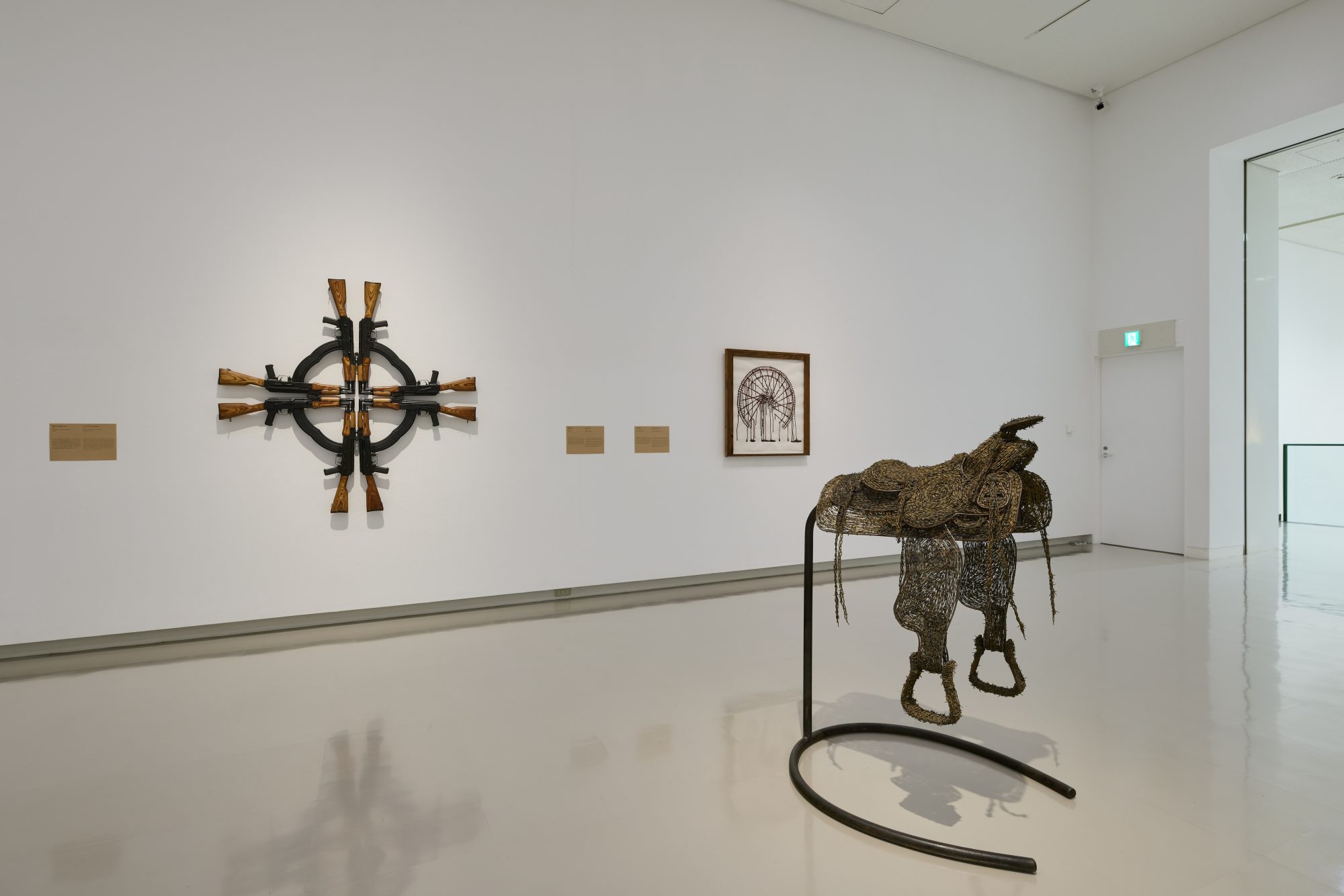 (left) Mel Chin, Cross for the Unforgiven (2002). Photo: Kenichi Hanada
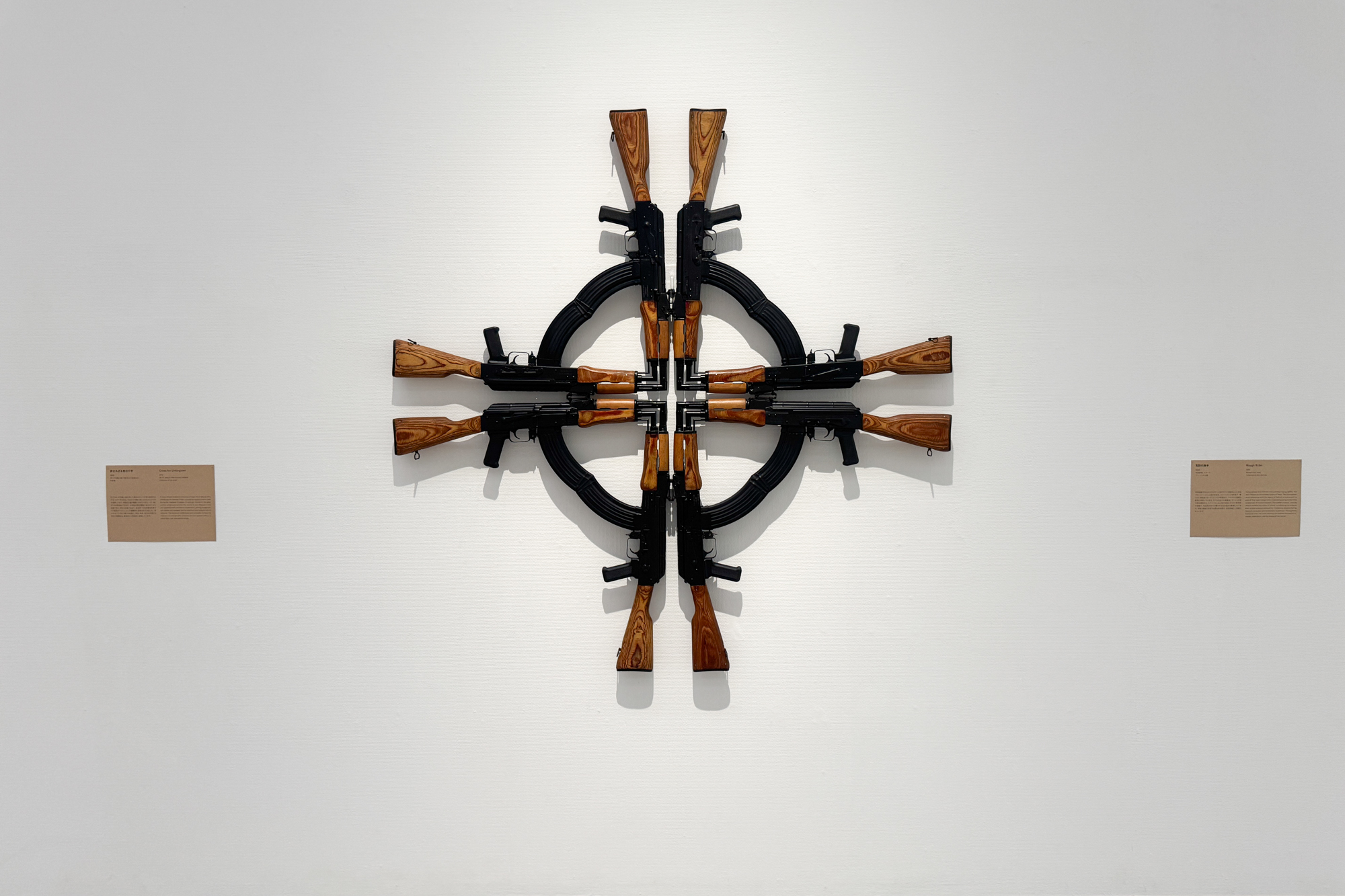 Mel Chin, Cross for the Unforgiven (2002)
Cross for the Unforgiven. You’re not supposed to have guns here in Japan, but here they are. But is this a gun? No, it’s not a gun. It’s actually eight Kalashnikovs, AK-47s, and here they’ve been joined into a cross. Let’s study the cross. It’s not straight up and down. This little flare at the ends indicates a Maltese cross. Look up the history. The Knights of Malta were in the Crusades, moving in to retake Jerusalem. That’s one aspect. Where else have we seen the AK-47 over and over again? It’s a symbol of victory over the West, because the Vietnamese used them against American forces. And yet it also leads to Osama bin Laden posing with the AK-47. These are symbolic elements, but here they’re welded into one, and if you pull the trigger, it will destroy itself. So this is also about the treachery of symbols being employed one way or another, because if a symbol serves power, and serves a direction that mediates your mind toward belief in one thing or another, it is ultimately destructive. Of course, this is just my IMHO — in my humble opinion.
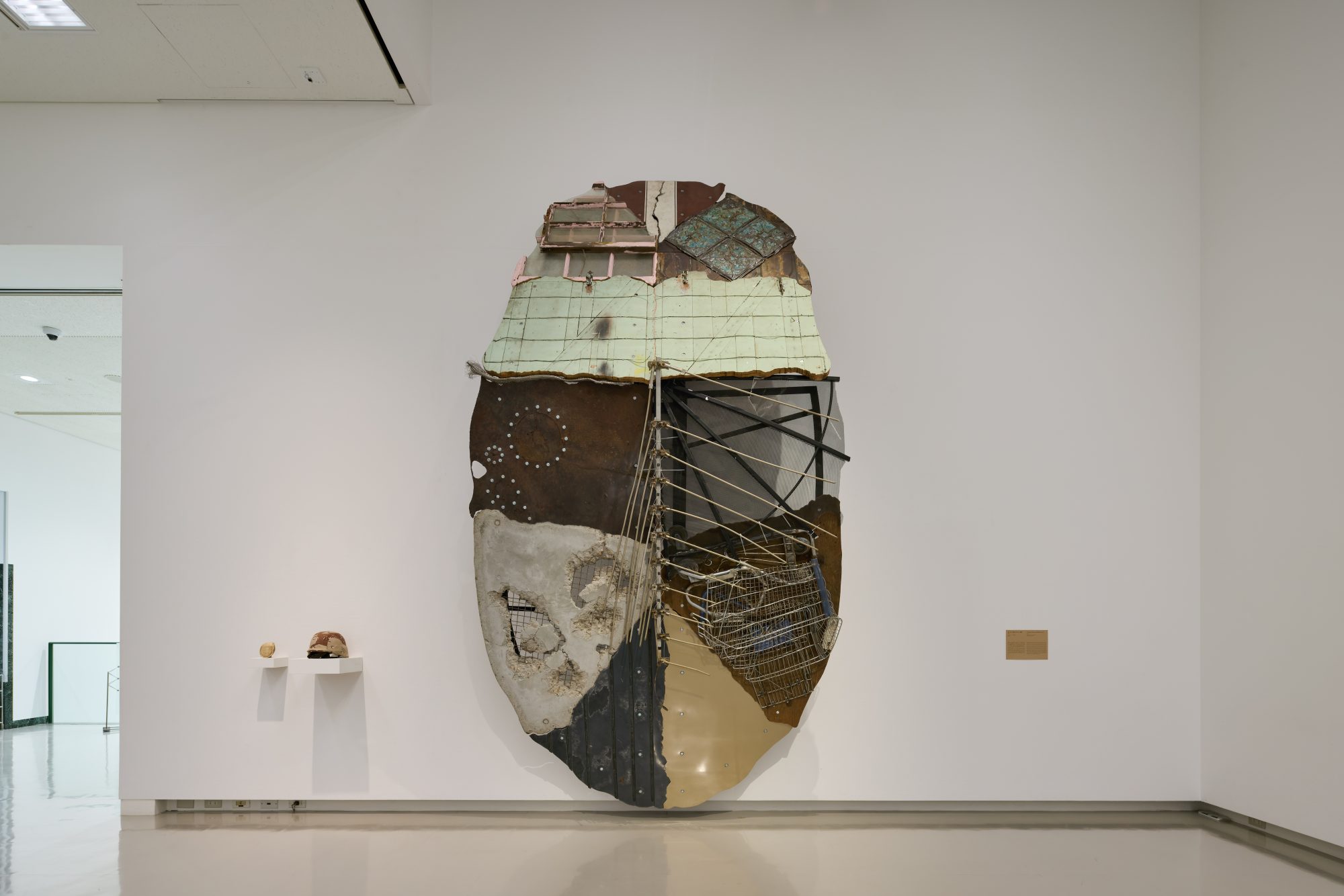 Mel Chin, Terrapine Carolina (Hillbilly Armor) (2005). Photo: Kenichi Hanada
This next piece involves a turtle. First, some words from Donald Rumsfeld: “Man and turtle are very much alike. Neither makes any progress without sticking his neck out.” That’s cool. I’m with that. The type of this turtle is a Tennessee box turtle, Terrapene carolina. He also said, “You go to war with the army you have.” This is former Secretary of Defense Donald Rumsfeld’s answer to Specialist Thomas Wilson of the Tennessee Army National Guard on December 8, 2004. Why did he say this? Because Specialist Thomas Wilson had said, “Secretary of Defense, we are putting pieces of junk — we call it hillbilly armor — under our vehicles because we are being blown up by improvised explosives on the road. And we have to protect ourselves.” He’s saying, “I’m sorry, you just go to war with the army you have.” He talked about money. But what the soldiers were talking about was that if they’re hit by a roadside bomb, the outcome is dramatic. They’re simply trying to protect themselves. The secretary is saying, “You just go do it. Sorry.” The army he had in 2004 was spending $257,808,219.18 per day. But they had no money to help protect the troops. I was moved by that, so I wanted to make something to represent this.
So what do you do? You go do your research. You look at the plastron of a Tennessee box turtle, and at a U.S. Army Humvee, which is about 15 feet long. You take these parts and put them together. Another aspect of how I make work is to look things up, use them as a point to create from, and try to be accurate. But I want you to pay special attention to this piece, Terrapine Carolina (Hillbilly Armor), because when you’re making things in the studio, it reminds me how seriously we have to make things. In the studio for this piece, I said, “When you look at these lines, I want you to recreate those very seriously. I want you to cut that line so carefully, as if your lives depend on it.” So you can echo your respect and your concern for someone else, even in making artwork.
Let me tell you about a film from 1962. It’s called Mondo Cane. It was made by Italian producers, in a genre that could be called exploitation. I was 11, maybe 10. Word had already reached the young people of the world that there was female nudity in the film. I wanted to see this film. Just curious. Lucky for me, it came to a local drive-in in Houston, Texas. I think it was the Tidwell Drive-In at that time. It had some important art-history documentation in it. It had the great artist Yves Klein creating a remarkable piece, and yes, it did show nudity. Many years later, it just came back to me. I hadn’t thought about the film in a long time. But I actually remembered none of the Yves Klein parts, though I had been trained as an artist. I did know that he saw the film at the Cannes Film Festival and had a heart attack. He died shortly after that. But what I did remember from childhood was the cargo cult: a belief among people on Melanesian islands, including Vanuatu, who made airplanes and landing fields out of bamboo in the hope that cargo would come. I was inspired enough to always think about them.
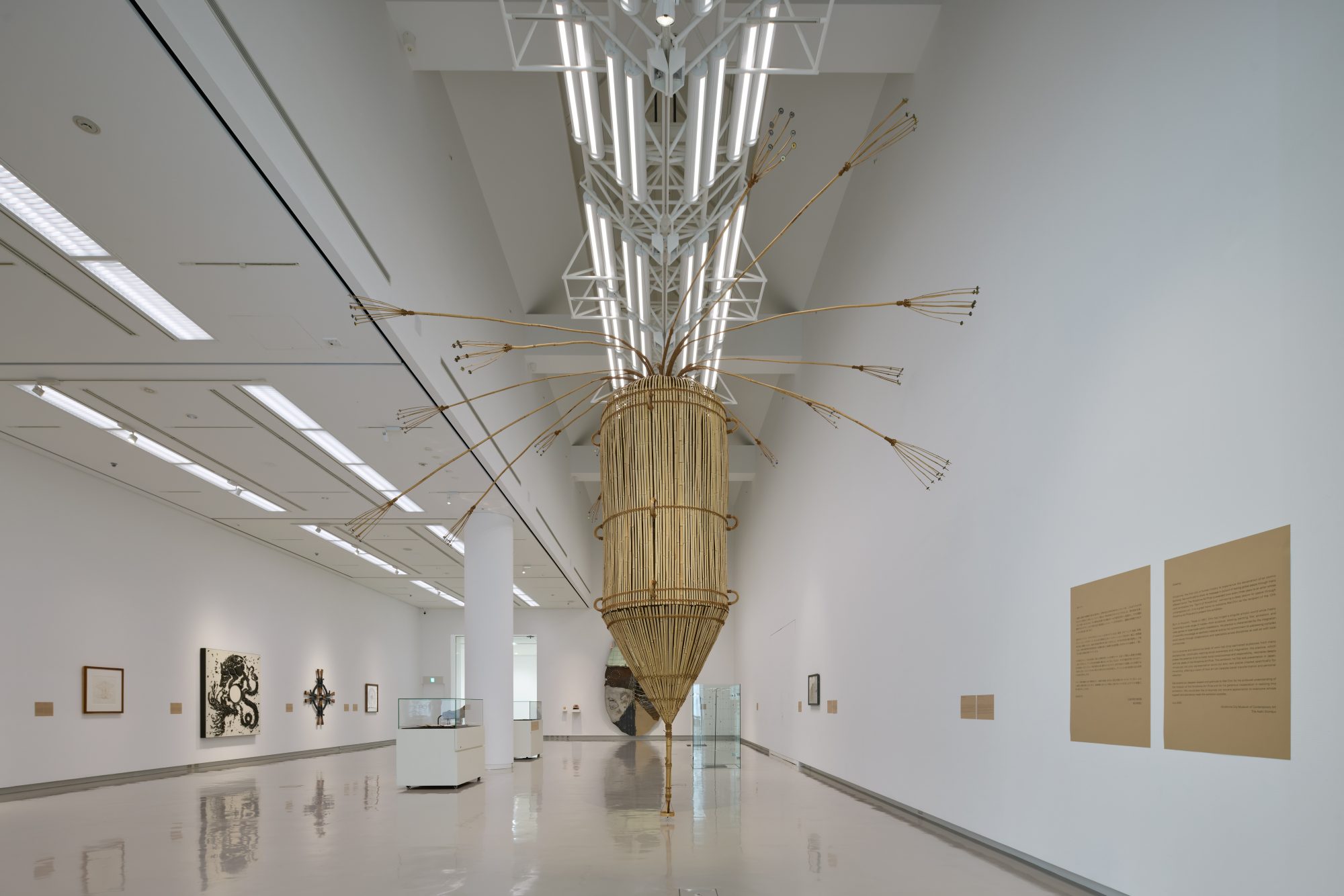 Mel Chin, Our Strange Flower of Democracy (2005). Photo: Kenichi Hanada
Making a work of art also can mean that, in your history, you retain certain things that, if not inspire you, compel you to make stuff. You search for a long time to make something. Why? Because I’m a conceptual artist, and it’s always the idea that reverberates first, and it’s not like any medium is sacred or special. If it has to be painting, it will be painting; maybe oil or acrylics. If it has to be glass, or if it has to be film, it will be. In this case, it had to be bamboo. It had to be bamboo, because I had learned about these islanders. And I said, what we need to make out of bamboo is this bomb, a full-scale replica of the Daisy Cutter used in Vietnam. The Daisy Cutter was used extensively to clear jungle. I think more than clearing jungle, it may have been partly responsible for the millions of lives lost in Vietnam because of the impact of this terrifying weapon. What made me think about the weapon again was that it was being used in Afghanistan. The rationale for using this weapon was that it’s a Daisy Cutter, so it clears jungle so you can land a helicopter. But there are no jungles in Afghanistan. In fact, they had to reclassify the weapon from that into an anti-personnel device. In other words, it was there to kill people. It was used as a terror weapon in Afghanistan.
When you hear news like this, you don’t really want to make a piece about it, but you have to wake up and say, “I have to.” Then you think, what can I make it out of? And it would have to be bamboo, because I was thinking about the whole story. So here it is, the bamboo bomb, Our Strange Flower of Democracy. As you know, it’s in this exhibition too. What’s sticking out of the top is mimicking hemlock. Hemlock was used to execute Socrates. He drank the poison because he questioned democracy: he was accused of corrupting the Athenian youth, and he took the poison as the punishment for that. This is an important point as well. Again, you may say, “Okay, Mel. I got your drift. I know where you’re coming from. But why did you make this bomb? What makes you make a piece like this?” The answer is a flyer dropped by the psychological operations unit, PSYOP, of the American military during the Gulf War. It shows an image of the Daisy Cutter, and in Arabic it says, “Flee and live. Stay and die.” I was just broken by this understanding. Of all the things that you say you’re about as an American, you could have dropped something like the Constitution to show, “This is how we want things to be. This is how we are. We’re not telling you to be this. But this is the option.” Instead, we dropped that leaflet. That’s why it’s the strange flower of democracy. Instead of dropping information or ideas to enrich a culture, we drop the leaflets and then the bomb.
The 12th Hiroshima Art Prize: Mel Chin
July 25 – October 12, 2026
Hiroshima City Museum of Contemporary Art, Gallery B
Curator: Motoko Suhama (Curator, Hiroshima City Museum of Contemporary Art)
https://www.hiroshima-moca.jp/exhibition/melchin
Unless otherwise noted, all images by ART iT.
The Lecture@Museum series presents lectures held in connection with exhibitions and related programs, edited and published by ART iT with the cooperation of those involved.