
“Bodies that Mourn: On Communicating with the Dead in Sound Performance”
What forms of art can commemorate and mourn the dead, especially victims of genocide? Ilavenil Vasuky Jayapalan’s “sonic monument of genocide and rebirth” presented one possibility, at times with violent intensity and at others with quiet dignity.
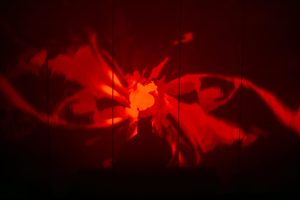 Performance Scene ©陳河好
This work is a sound performance by an Eelam Tamil artist living in Norway, commemorating the Tamil people who perished in the massacres during Sri Lanka’s civil war. The venue, set up in the Kyoto Art Center’s Multi-purpose Hall, was divided between audience and performer by a screen, filled with intense red lighting, smoke, and the scent of incense. Projected onto the screen was the shadow of a figure at a turntable. This was the shadow of the performer, Ilavenil himself, surrounded by constantly shifting psychedelic geometric patterns.
At the beginning, a slow Tamil love song plays as the shadow slowly moves its hands in a dance. This song, implying the longing for home felt by the diaspora Tamil people, resonates powerfully throughout the venue. Combined with the shadow’s dance, it evokes an atmosphere of prayer. Gradually, noise resembling human screams emerges, and intense flickering of red light begins, heightening the tension. While the drum set creates a regular, danceable rhythm, sounds and lights reminiscent of explosions and gunfire erupt irregularly. As the audience surrenders to the intense sound and shifting lights, peace returns with a human’s singing, concluding the journey of destruction and rebirth.
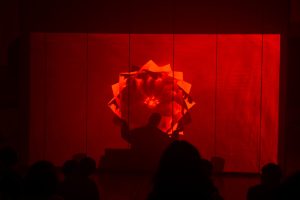
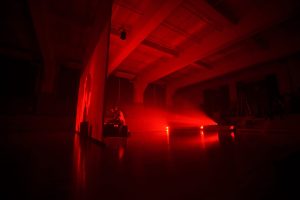 Performance Scene ©陳河好
Although this work carries the explicit theme of remembering and mourning the massacred Tamils, it contains no specific images or words directly pointing to them. Furthermore, performers and audience remain separated by a screen throughout, the performers’ faces never revealed. Such abstraction has frequently been employed as a strategy to evade the watchful eye of oppression in artistic works making political statements, regardless of country or region. This work may also be situated within that lineage. Indeed, considering the fact that since 2009, monuments and acts of commemorating the victims of the Tamil genocide have been targets of suppression, the work’s abstraction can be seen as a form of resistance against such circumstances.
On the other hand, it can also be noted that the elimination of images creates a unique effect within the work. For instance, the black, featureless human silhouette projected onto the screen becomes a shadow that could be anyone precisely because it is no one. This creates space for the audience to project their own imagination. The shadow appears to be one who presides over the memorial ritual, yet simultaneously resembles the silent figures of the nameless victims. Through manipulation of lighting, this shadow repeatedly splits and converges, visually demonstrating that it is both one and many. Thus, the performer’s shadow acquires multiple layers, with diverse dead and living figures appearing and vanishing within his body.
Moreover, the removal of images imbues this work with a certain sacredness. The explosions of light and sound occurring without concrete imagery evoke the calamity wrought by an unseen deity, drawing the audience into the Naga (serpent deity) myth of destruction and rebirth that underlies this piece. An overwhelming sense of majesty fills the space. Even amidst the pulsing, danceable music, the audience constantly senses the presence of otherworldly beings through the flickering light and the fracturing of the performer’s shadow. This balance between the work’s intense, immersive quality and its mechanisms for evoking the presence of the unseen is what makes this performance unique.
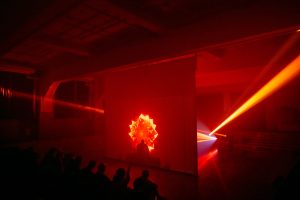 Performance Scene ©陳河好
The essence of this work resonates profoundly with the Noh theater, which Ilavenil encountered during his residency in Kyoto. Having studied Noh mask-making throughout his residency, Ilavenil observes that the slow movements of Noh contain an intensity. Just as in Noh, the restrained movements of the shadow in his work, precisely because they are quiet, contain a fierce energy within them. And just as a Noh play which guides the spirits of the dead to salvation with the resounding chanting and music, Ilavenil communes with otherworldly beings through sound, leading them to rest after a fierce struggle. The themes inherent in this work—communion with the dead and the salvation of their souls—were brought into sharp focus during the performance in Kyoto through the encounter with Noh’s physicality and spirituality.
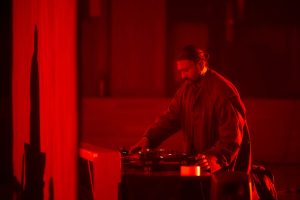 Performance Scene ©陳河好
As history shows, the ethnic conflict in Sri Lanka has its roots in the divide-and-rule policies of the British colonial era. The divisions and genocides brought about by colonialism continue to produce victims around the world to this day. This work suggests an attitude we can adopt amidst such realities. That is, commemorating the victims is not something done from a safe distance, detached from death, but is achieved through an intense communication with the dead. It is precisely in this sincerity that this work finds hope for the restoration of humanity.
Satoshi Kariki
Born in 1991, Kariki Satoshi graduated with an MA in Literature from Kyoto University Graduate School of Letters. While working as an English teacher, he has been involved in translating exhibition catalogs, video works and interviews. Recent major exhibitions include “Olafur Eliasson: A harmonious cycle of interconnected nows” (Azabudai Hills Gallery, 2023) and “Theaster Gates: Afro-Mingei” (Mori Art Museum, 2024).
【Performance Information】
“sonic monument of genocide and rebirth”
Sound Performance directed and performed by Ilavenil Vasuky Jayapalan(NAGAVER)
Date:2025. November. 29. Sat. 17:00 start
Venue:Kyoto Art Center Kyoto Art Center Multi-purpose Hall
More Info. here