
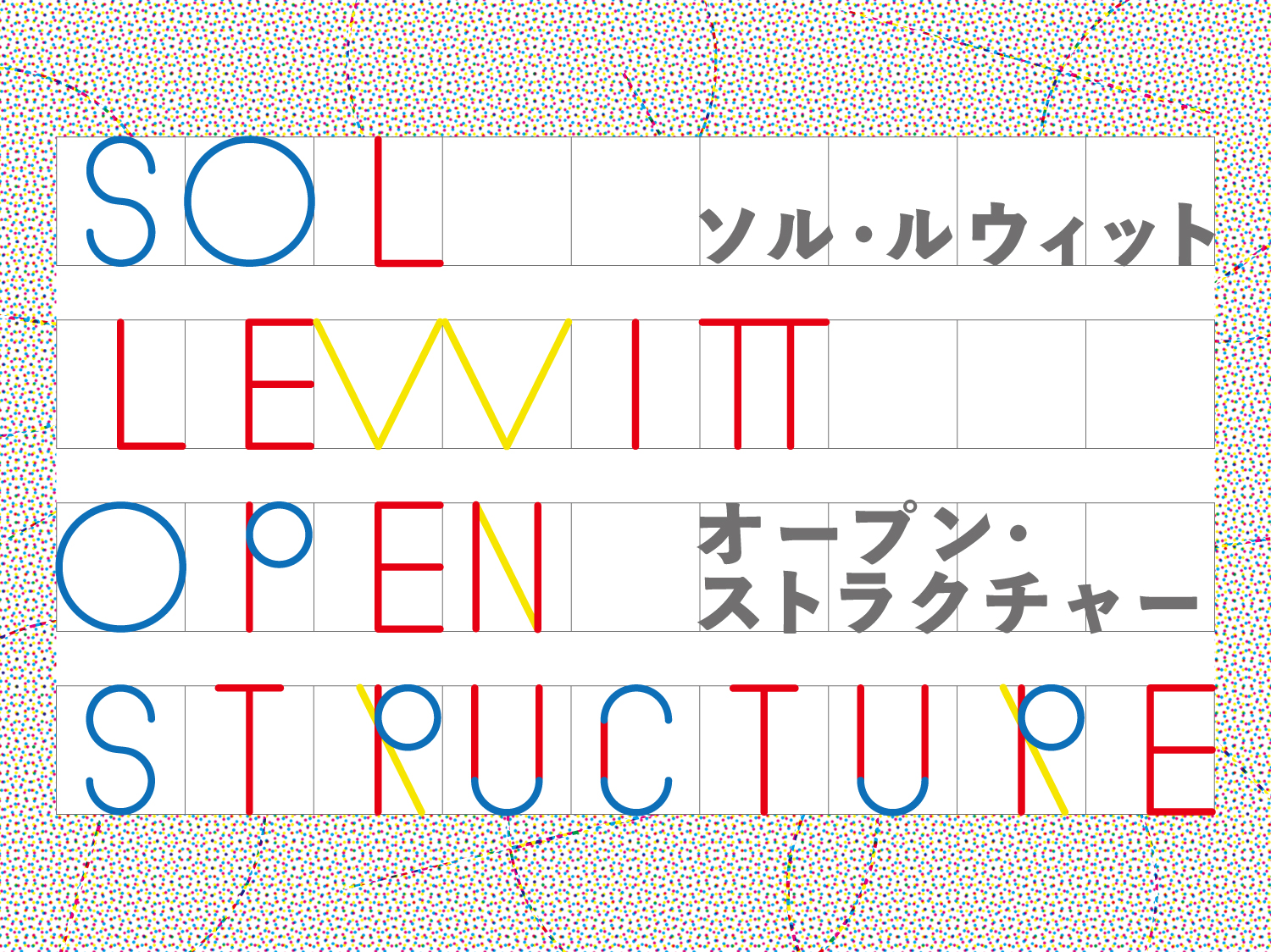
Sol LeWitt: Open Structure
December 25, 2025 – April 2, 2026
Museum of Contemporary Art Tokyo
https://www.mot-art-museum.jp/en/
Opening Hours: 10 AM-6 PM (Tickets available until 30 minutes before closing.)
Closed: Mondays (except Jan 12, Feb 23), Dec 28–Jan 1, Jan 13, Feb 24
Organized by Museum of Contemporary Art Tokyo operated by Tokyo Metropolitan Foundation for History and Culture with the cooperation of the Estate of Sol LeWitt
Sol LeWitt (1928–2007), one of the most influential American artists of the latter half of the twentieth century, is renowned for exploring the possibilities of what art can be through works focused on ideas. This exhibition, the first substantial survey of his art at a public museum in Japan, offers an overview of his expansive practice, encompassing wall drawings, structures, works on paper, and artist’s books that radically transformed the terms of artistic production.
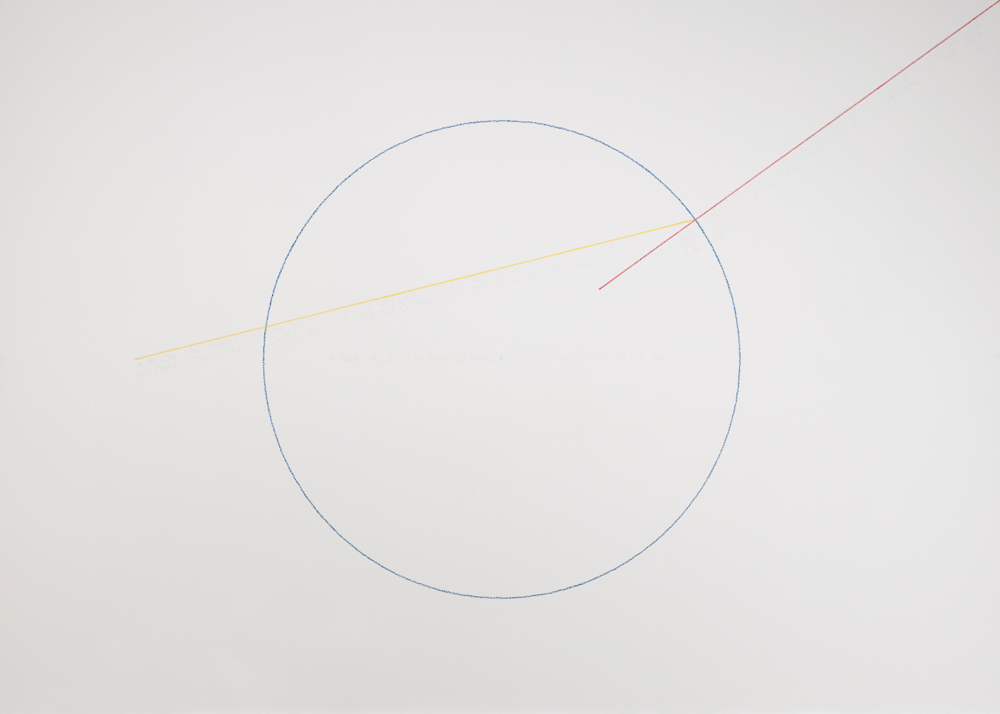
In the 1960s, LeWitt challenged the conventional notion that art expresses the artist’s inner self or emotions. By combining cubes as basic units into modular structures, he demonstrated how serial progression could determine the form of a work, as in Structure (One, Two, Three, Four, Five as a Square) (1978-80). For him, the origin and core of artistic creation lay in its underlying idea, structure, plan, or process, not in the object itself. He articulated this principle in his seminal essay “Paragraphs on Conceptual Art” (1967): “When an artist uses a conceptual form of art, it means that all of the planning and decisions are made beforehand and the execution is a perfunctory affair. The idea becomes a machine that makes the art.” One of LeWitt’s lifelong projects, wall drawings began with the first installation at Paula Cooper Gallery in 1968 and ultimately comprised over 1,300 pieces. Most were executed not by the artist himself but by others following his instructions or diagrams, and were often painted over after exhibitions. This approach and process serve to question the premises of authorship, permanence, and uniqueness in art. Beginning in the 1980s, his work featured more complex forms and superimposed vibrant, opulent hues. These developments, however, remain consistent with his prior practice based on simple systems and instructions and represent an expansion of the scope of his artistic thought. In this exhibition, six wall drawings will be presented, offering visitors the opportunity to experience the unfolding of LeWitt’s conceptual approach.
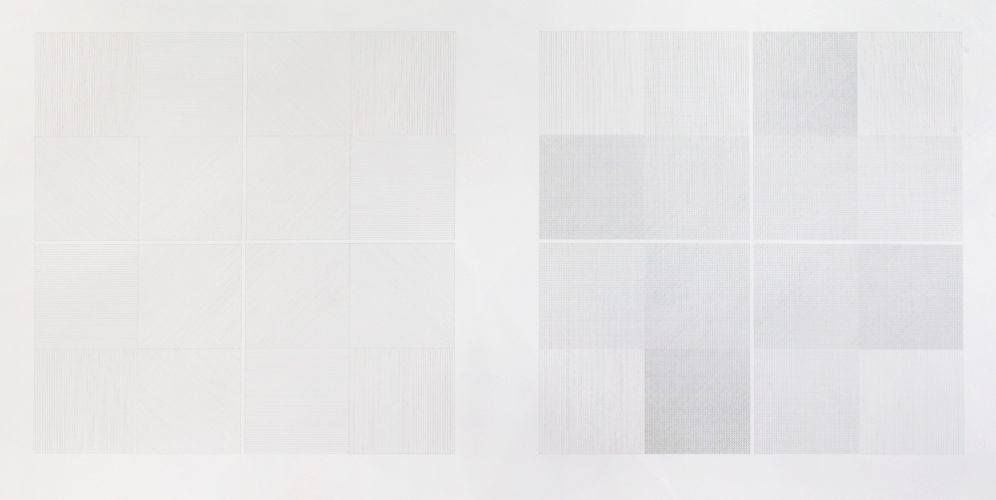
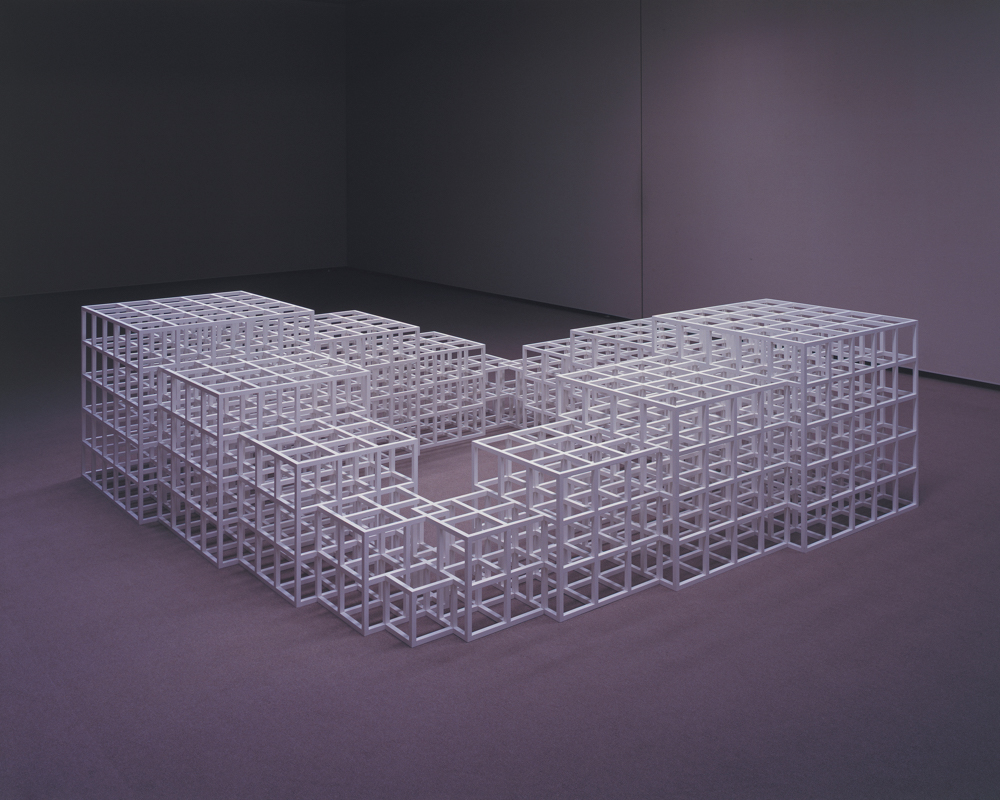
This exhibition illuminates the notion of “open structure,” which characterizes LeWitt’s art. Many of his cubic works expose the framework that supports their forms by eliminating surfaces and emphasizing side lines. Works such as Incomplete Open Cube (1974), where certain edges are absent, evoke the dynamics of a structure in a state of sequential transformation, much like a single frame in chronophotography, thus dismantling notions of perfection and invariability. It is also notable that his wall drawings can take on different forms depending on the space and conditions in which they are installed, as well as those who execute them. No matter how precisely the artist’s instructions are followed in translating ideas into form, a degree of unpredictability and interpretation by others inevitably intervenes, an aspect the works embrace. His statement, “Ideas cannot be owned. They belong to whoever understands them,” reflects his belief in resisting the notion that ideas are the property of a single person and in committing to sharing them with all who might receive them. To make his ideas more accessible, LeWitt produced numerous artist’s books. This led him to co-found Printed Matter in 1976, with art critic Lucy R. Lippard and others, an organization dedicated to distributing artists’ books independent of the established art market.
From the 1960s onward, as art came to be regarded not merely as an object to be viewed but as a space for thought, LeWitt played a decisive role and has remained a lodestar, particularly in the field of idea-driven and instruction-based art. By reconfiguring existing systems and structures and opening a creative interstice within them, his work suggests possibilities for alternative perspectives and frameworks, offering opportunities to reflect on how we perceive and engage with the world.
Concurrent Exhibitions
Tokyo Contemporary Art Award 2024-2026 Exhibition Exhibition Gallery 3F (December 25, 2025– March 29, 2026)
https://www.mot-art-museum.jp/en/exhibitions/TCAA_2024_2026/
MOT Collection 30th Anniversary Exhibit
Multiple Self-portraits
Special Feature NAKANISHI Natsuyuki IKEUCHI Akiko: Arc and Catenary
(December 25, 2025– April 2, 2026)
https://www.mot-art-museum.jp/en/exhibitions/mot-collection-251225/
mission∞infinity | space + quantum + art (January 31 – May 6, 2026)
https://www.mot-art-museum.jp/en/exhibitions/mission-infinity/